AI Assistant for Online Gambling Prevention
Conversational assistant with RAG architecture for the early detection and prevention of problem gambling in young people: distributed architecture, real-time inference, and privacy-by-design.
1. What this is about
This project was my Final Year Project (Proyecto Integrador) for my Computer Engineering degree at UNSL, and it was graded 10 out of 10. But beyond the grade — which I won’t pretend didn’t make me pretty happy — it’s the project I’m most proud of for what it actually means. I built it alongside researchers from the Psychology Faculty for the University Program for the Prevention of Problematic Substance Use and Addictive Behaviors. The result: a conversational assistant with RAG architecture that provides a confidential, empathetic, and psychoeducational channel for the early detection of risk behaviors related to digital gambling addiction in teenagers. Validated in the field with over 50 simultaneous concurrent users.
2. The problem: gambling, stigma, and a generation with no safety net
The explosive growth of digital wallets, online casinos, and sports betting platforms triggered an emerging crisis of gambling addiction and early debt among high school and university students. This isn’t alarmism — it’s what the psychologists I worked with documented firsthand.
Why the problem was hard to solve with existing tools
- Traditional channels pushed them away: Conventional support resources — in-person talks, addiction hotlines — face strong rejection from young people. Fear of school punishment, losing privacy, or being judged by their family means teenagers simply don’t use those resources. The problem goes unaddressed.
- Nobody explained how probability actually works: Young people fall for logical fallacies reinforced by the gamification of betting (the illusion of control, the gambler’s fallacy). They had no interactive tools that could break down the math in their own language.
- Researchers had no data: The mental health team had no standardized way to gather empirical field metrics — conversation patterns, emotional indicators, risk levels — without violating anonymity or the ethical guidelines of Argentina’s data protection authority (AAIP). No data, no way to scale the intervention.
3. Key engineering decisions
Decoupled distributed architecture: Next.js (Vercel) + dedicated Python server (UNSL)
The conversational assistant needs minimal latency and smooth streaming to hold a teenager's attention on mobile — if the response takes too long, they're gone. Text analysis with Transformers (pysentimiento, emotion detection, irony detection, and analytical Excel exports) is CPU-intensive. Mixing both in the same process meant heavy computations would either block the web event loop or drive up serverless costs. Splitting them was the right call.
Python monolith (FastAPI/Streamlit) or unified processing in Next.js: Ruled out due to the risk of chat latency degradation during peaks of concurrent statistical computation.
Choosing Gemini 2.5 Flash with native reasoning
According to independent benchmarks from Artificial Analysis (August 2025), Gemini 2.5 Flash sat in the optimal quadrant: top output speed (tokens/second) to keep conversations feeling instant, a 58-point intelligence index with built-in reasoning to follow clinical guidelines, and a cost that actually makes sense for a public university. It wasn't the most powerful model on the market, but it was the right one for this problem.
Local models (Llama 3 / Mistral) or frontier LLMs (GPT-4o / Claude Opus): Running models locally required GPU hardware well beyond what was feasible for 50+ concurrent users; frontier models drove up token costs without adding meaningful value for short guidance-oriented conversations.
Markdown normalization before semantic chunking (600 chars + overlap)
Psychology manuals and clinical guidelines in PDF come with complex layouts (two-column text, tables, footnotes) that corrupt the vectorization if ingested raw. Converting them to Markdown first preserves the document's semantic structure, and splitting into natural sentences with overlap prevents key clinical concepts from getting cut in half — which is exactly what you can't afford in a health system.
Direct plain-text extraction from PDFs or fixed-size chunking: Ruled out for producing semantic false positives and hallucinations when clinical definitions get split in the middle.
Privacy by design (AAIP) and encryption at rest (AES-256-GCM)
Under Argentina's Law 25.326 and the AAIP's recommendations for responsible AI, the system operates with anonymous public access — no registration of any kind — and short-lived ephemeral credentials for school-based sessions. All message and metric persistence is encrypted at rest using AES-256-GCM with segregated keys. If a teenager has to create an account with their email and national ID just to ask for help, they simply won't do it. It's that simple.
Plaintext storage or mandatory authentication with email/national ID: Ruled out to comply with the data minimization principle and avoid mistrust from minors sharing personal gambling situations.
4. System Architecture
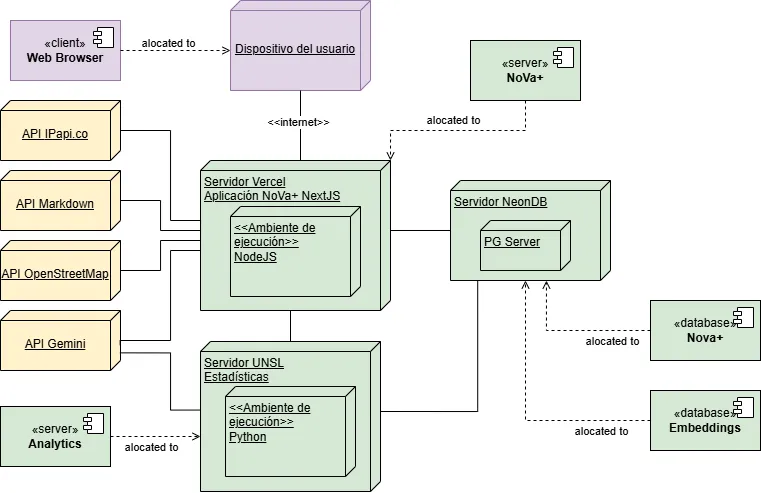
The system runs on a distributed multi-node topology: a serverless Next.js web app deployed on Vercel’s edge network, handling the interactive UI and message streaming via the Vercel AI SDK, connected to a PostgreSQL database with the pgvector extension on NeonDB in the same geographic region to minimize round-trip times. An on-premise Python backend server, hosted on UNSL’s physical infrastructure, handles background analytical processing.
Infrastructure and physical deployment
RAG inference pipeline and data flow
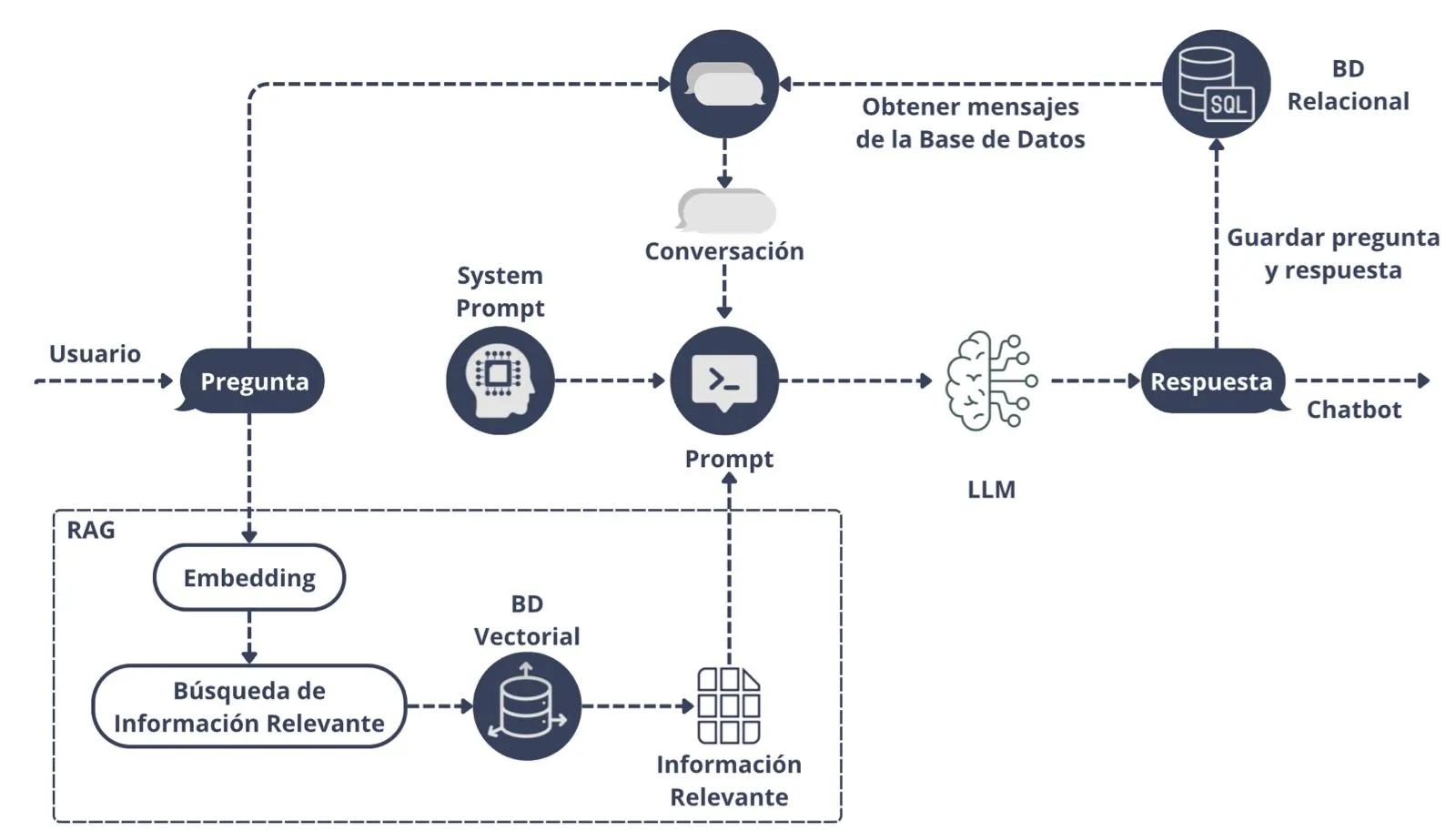
The full cycle in 4 phases:
- Document ingestion and segmentation: Converting clinical literature to Markdown, adaptive chunking into 600-character segments with overlap, and generating vector embeddings.
- Contextual retrieval: Nearest-neighbor search via pgvector to retrieve the document fragments most semantically similar to the student’s query.
- Guardrail injection and assisted generation: Building the unified prompt (ethical System Prompt + conversation history + initial intake form + bibliographic chunks) and streaming the response via Gemini 2.5 Flash.
- Asynchronous NLP analysis and auditing: AES-256-GCM symmetric encryption for secure storage in NeonDB, and evaluation on the Python server with
pysentimientoto classify polarity, emotions, and risk indicators for the research team.
5. The challenge that made me think the hardest
An LLM that wants to diagnose vs. a non-negotiable “no clinical diagnosis” rule
This was the most interesting design problem in the project, and the one that took the most hours to get right.
- The dilemma: Language models naturally tend to please the person they’re talking to and to make confident, definitive statements. “You show signs of moderate gambling disorder” is exactly the kind of thing an unrestricted LLM might say — and in a system that serves at-risk teenagers, that was a real and critical ethical problem.
- How I solved it: I designed a context engineering architecture with strict guardrails in the System Prompt. The assistant is fully blocked from making diagnostic statements or prescriptions. Its role is limited to active and non-judgmental listening, clarifying mathematical probability myths, and guiding users toward support networks and official health centers (including geolocated resources in San Luis).
- Trade-off accepted: I prioritized ethical rigor and clinical safety over the model’s expressive freedom — constraining its response boundaries, but guaranteeing a trustworthy environment backed by psychology specialists. An LLM that diagnoses is a legal and human problem. One that listens and refers people to help is a useful tool.
6. Results: the numbers
- Perfect grade: Approved 10/10 by the UNSL evaluation committee.
- Stress validation (50+ concurrent users): Held up under simultaneous load tests in school classrooms and university sessions, handling 92 visitors, 125 sessions, and over 2,300 messages with no downtime or latency degradation.
- Measured web performance (Vercel Speed Insights):
- Real Experience Score (RES): 97 out of 100.
- First Input Delay (FID): 3 ms average (98% rated excellent).
- Time to First Byte (TTFB): 0.23 seconds average (96% rated excellent).
- Interaction to Next Paint (INP): 96 ms average (92% rated excellent).
- RAG fidelity and usage: 95% of responses explicitly integrated content retrieved from the bibliographic knowledge base. The model didn’t make things up.
- Acceptance and usability: Average rating of 4.8/5 stars in conceptual feedback and 4.4/5 on the Likert scale for perceived utility.
- Academic dissemination: Papers and posters presented at the 13th National Congress of Computer Engineering (CoNaIISI 2025, Córdoba), the Mental Health Congress (Mendoza 2025), and the 3rd University Conference on Health and Problematic Substance Use (UNSL).
7. What I’d do differently today
If I were redesigning the solution today, I’d add a continuous automated RAG evaluation pipeline using frameworks like Ragas or TruLens, computing faithfulness, context recall, and answer relevancy metrics automatically on every content update. I’d also implement an alternative channel via WhatsApp Cloud API or an offline-capable PWA, to remove the connectivity barrier for teenagers in rural schools or with limited data plans. Because if the channel doesn’t reach where the problem is, none of it matters.